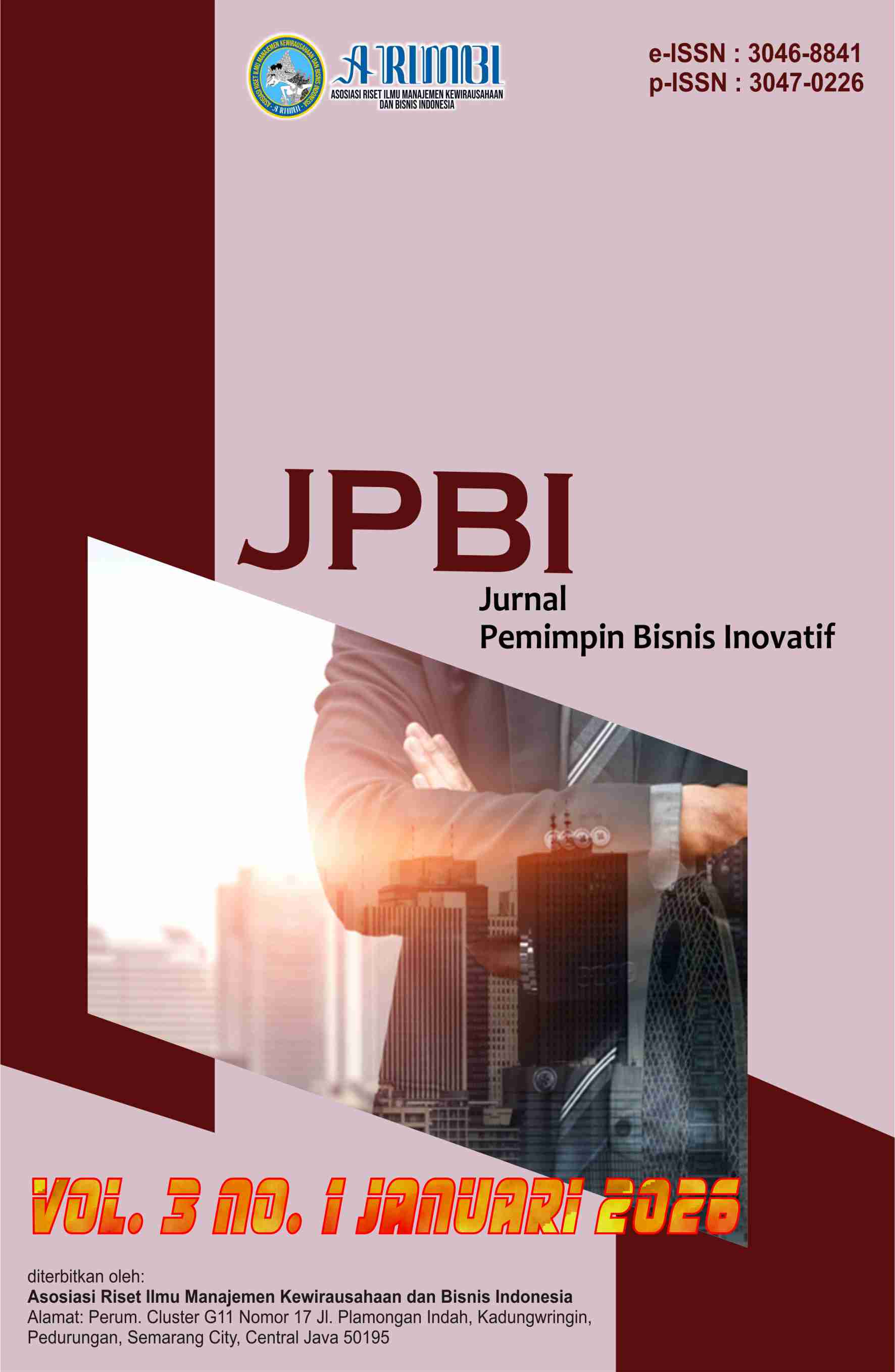
Peran Budaya Kolaboratif dalam Meningkatkan Kinerja dan Daya Saing Organisasi Modern
DOI:
https://doi.org/10.61132/jpbi.v3i1.1196Keywords:
Collaboration, Collaborative Culture, Digital Transformation, Organizational Culture, Organizational PerformanceAbstract
The rapid development of globalization and the acceleration of digital transformation have encouraged organizations to adopt more adaptive and collaborative work practices. In this context, collaborative culture has become a strategic element that plays a crucial role in enhancing organizational effectiveness and competitiveness. This study aims to comprehensively examine the concept, characteristics, forming factors, and theoretical foundations of collaborative culture in modern organizations. The research employs a qualitative approach through a literature review, analyzing reputable national and international journal articles, textbooks, and relevant institutional reports. Data analysis is conducted using a descriptive-analytical technique by synthesizing findings from previous studies. The results indicate that collaborative culture significantly contributes to improved communication quality, work coordination, adaptability, and both individual and organizational performance. Collaborative culture is shaped through the integration of shared vision, open communication, trust, willingness to share resources, collaborative leadership, flexible organizational structures, and the support of collaborative technologies. This study also highlights that the success of digital transformation largely depends on the strength of an effectively internalized collaborative culture. The findings are expected to provide a theoretical reference for organizations and researchers in developing sustainable collaborative culture strategies.
Downloads
References
Abdelrahman, M., et al. (2025). Organisational culture and knowledge management systems adoption: The role of technology acceptance. Springer. https://doi.org/10.1007/s40171-025-00448-w
Amalia, R., & Prakoso, B. (2021). Hubungan dukungan sosial dan kepuasan kerja karyawan pada organisasi modern. Jurnal Psikologi Industri, 9(2), 112–125.
Authors. (2025). The role of collaboration technology and knowledge-sharing climate in organizations. KPM Journal.
Barker Scott, B. A., & Manning, M. R. (2022). Designing the collaborative organization: A framework for how collaborative work, relationships, and behaviors generate collaborative capacity. The Journal of Applied Behavioral Science, 60(1), 149–193. https://doi.org/10.1177/00218863221106245
Barker Scott, B. A., & Scott, B. (2024). Designing the collaborative organization. SAGE.
Bock, L. (2020). Work rules!: Insights from inside Google that will transform how you live and lead. Hachette.
Cameron, K. S., & Quinn, R. E. (2021). Diagnosing and changing organizational culture (4th ed.). Wiley.
Dewi, A., & Prabowo, H. (2022). Collaborative climate and team innovation outcomes in Indonesian organizations. Jurnal Manajemen dan Kewirausahaan, 24(1), 33–45.
Dhir, S., & Shukla, A. (2021). Collaborative culture and organizational agility: A systematic review. European Business Review, 33(5), 742–766. https://doi.org/10.1108/EBR-07-2020-0178
Dirks, K. T., & Ferrin, D. L. (2021). Trust in leadership and organizational performance. Academy of Management Perspectives.
Fitria, N., & Sari, M. (2021). Collaborative structures and organizational responsiveness toward market change. Jurnal Administrasi Bisnis, 18(3), 201–214.
Harney, B., & Monks, K. (2021). Strategic HRM: Research and practice.
Hartono, D. (2023). Collaborative culture and conflict resolution effectiveness in hybrid workplaces. Journal of Organizational Development, 7(1), 45–60.
Hassan, M., & Fikri, A. (2023). The role of cross-functional collaboration in driving innovation performance. Asian Journal of Business and Management, 15(2), 77–89.
Homans, G. C. (1958). Social behavior as exchange. American Journal of Sociology, 63(6), 597–606. https://doi.org/10.1086/222355
Huang, J. L. (2024). Empowerment leadership and cooperative decision-making in software teams. Journal of Software: Evolution and Process, 36(1), e2451.
Imai, M. (2021). Kaizen: The key to Japan’s competitive success (Rev. ed.). McGraw-Hill.
Khan, M. A. (2024). Examining the influence of organizational structure and leadership on innovation in hybrid work settings: The mediating role of organizational culture. Journal of Innovation & Management. https://doi.org/10.21203/rs.3.rs-5472336/v1
Lee, R., & Chen, F. (2022). Collaborative culture and affective commitment among employees in digital workplaces. International Journal of Human Resource Studies, 12(1), 55–70.
Leso, B. H., Coccia, M., et al. (2023). The contribution of organizational culture, structure, and leadership to digital transformation in SMEs. Organization Science. Springer.
Lestari, D., & Haris, M. (2022). Employee engagement and productivity in collaborative teams. Jurnal Sumber Daya Manusia, 6(1), 41–52.
Lestari, S., & Gautama, A. (2023). Collaborative learning culture and organizational adaptability in the digital era. Jurnal Ilmu Manajemen, 11(2), 150–164.
Men, L. R., & Jiang, H. (2021). Strategic internal communication and teamwork effectiveness. Public Relations Review.
Morales-Huamán, et al. (2023). Culture, identity, and collaboration in public and private organizations. Administrative Sciences.
Newman, A., Donohue, R., & Eva, N. (2020). Psychological safety and collaborative behavior in organizations. Human Resource Management Journal, 30(2), 233–247.
Nguyen, T., Pham, Q., & Lee, J. (2021). Collaborative culture and team coordination effectiveness in modern organizations. Journal of Management Research, 14(3), 88–103.
OECD. (2022). Building innovative and collaborative organizations. OECD Publishing.
Paredes-Saavedra, M., Vallejos, M., Huancahuire-Vega, S., Morales-García, W. C., & Geraldo-Campos, L. A. (2024). Work team effectiveness: Importance of organizational culture, work climate, leadership, creative synergy, and emotional intelligence in university employees. Administrative Sciences, 14(11), 280. https://doi.org/10.3390/admsci14110280
Putra, A., & Rahman, T. (2021). Team collaboration and interpersonal conflict reduction in the workplace. Jurnal Psikologi Terapan, 13(2), 99–110.
Putri, R. A., Hidayat, D., & Nurjannah, D. (2024). Teamwork, innovative behavior, and work motivation as predictors of employee performance. Journal of Human Resource Development, 12(1), 44–57.
Rahman, S., & Abdullah, W. (2022). Team collaboration and readiness for organizational change. Journal of Behavioral Science, 9(4), 129–140.
Rahman, Y., & Wijaya, L. (2023). Impact of collaborative practices on cycle time efficiency in project-based organizations. Jurnal Produktivitas Kerja, 4(1), 25–39.
Scott, D., & Barker, A. (2024). Designing the collaborative organization. SAGE.
Shi, X., Jiang, Y., & Wang, Z. (2023). Task interdependence and cooperative behavior in collaborative projects. Group & Organization Management, 48(6), 1156–1178.
Sulistiyani, E., Raharjo, K., & Solimun. (2022). Work–life balance and employee engagement: The mediating effect of organizational support. Management Science Letters, 12(4), 301–314.
Susanto, A., & Heryanto, B. (2023). Collaborative culture and turnover intention among millennial employees. Jurnal Human Capital, 5(2), 60–72.
Sutanto, D. (2022). Gotong royong as social capital in modern community development. Jurnal Sosial dan Budaya, 10(1), 15–27.
Tajfel, H., & Turner, J. C. (1979). An integrative theory of intergroup conflict. In W. G. Austin & S. Worchel (Eds.), The social psychology of intergroup relations (pp. 33–47). Brooks/Cole.
Teece, D. J. (2021). Dynamic capabilities and organizational adaptation in digital environments. Strategic Management Journal, 42(5), 1023–1045.
West, M. A. (2020). Effective teamwork: Practical lessons in organizational success. Wiley.
Wijaya, R., & Santoso, H. (2022). Collaborative climate and reduction of destructive conflict in organizations. Jurnal Organisasi dan Manajemen, 9(2), 120–131.
Zhang, Y., & Kim, S. (2020). Psychological safety, collaboration, and employee innovation behavior. Journal of Organizational Psychology, 20(3), 44–59.
Downloads
Published
Issue
Section
License
Copyright (c) 2026 Jurnal Pemimpin Bisnis Inovatif

This work is licensed under a Creative Commons Attribution-ShareAlike 4.0 International License.